
Repertoire? Library? Hoard? The Soul Motion "Stacks"
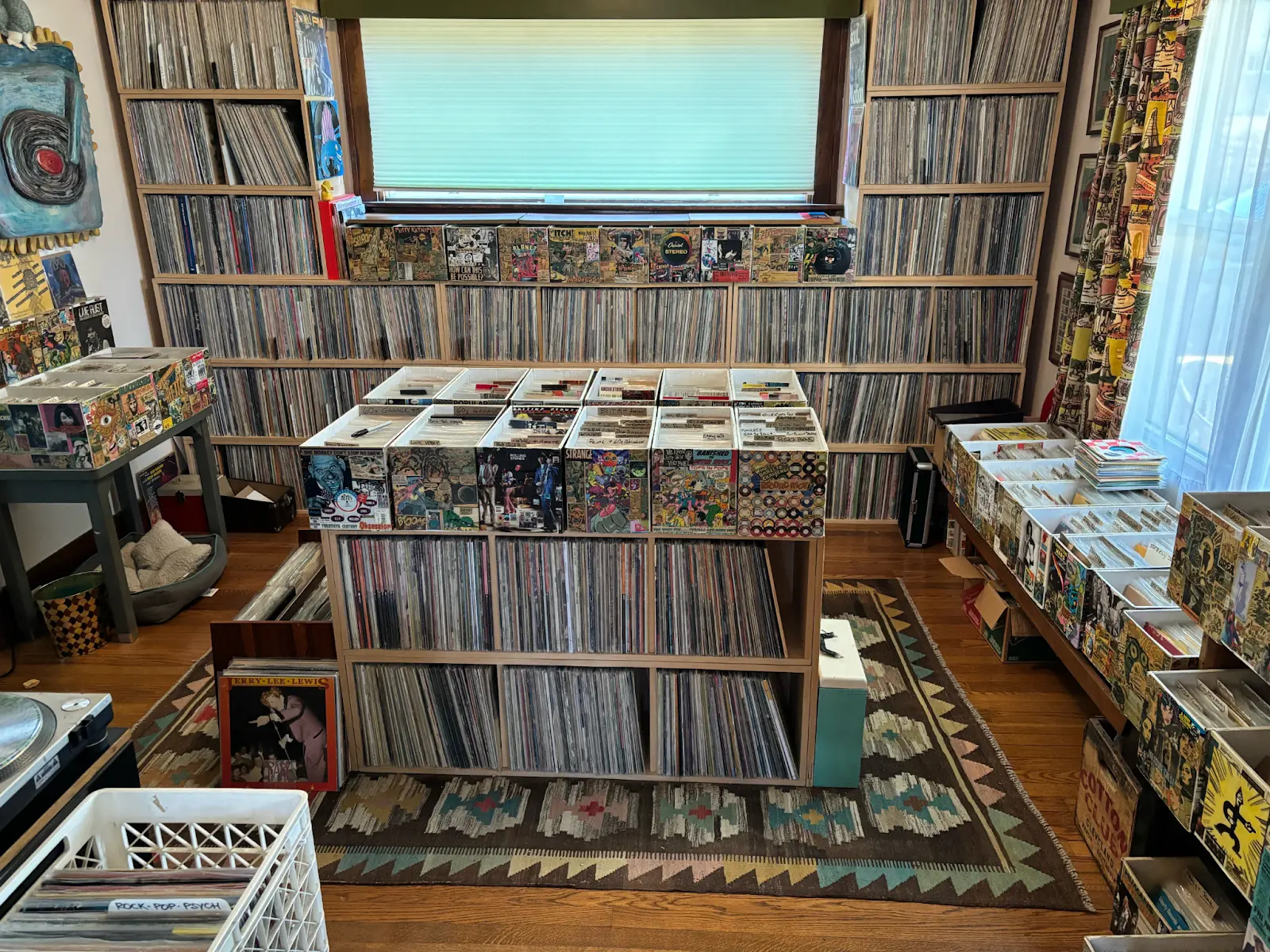
If you’re going to be a “professional” vinyl DJ, you presumably need a large library of records. But the question is: is the library there to support the DJing, or is the DJing the excuse to maintain, grow, and obsess over the library?
Probably, honestly, best not to think about it. But think about it I can, and think about it I do! I’ve been working on building this library for over 30 years - maintaining a collection for an institution that exists only in my head, on my radio show, and whenever I go out to do shows. To my way of thinking, if I’m not DJing, I am just a guy with more records than I can play. I can never quit DJing – what would I do with all of these records otherwise?
Therefore, it seems like a good place to begin this blog feature, by introducing my primary “partner” in DJing – that multi-ton, multi-genre collective monstrosity of individual entities, the Soul Motion Stacks.
My guess is that it’s about one third LPs, two-thirds 45s, although we’ll talk about the actual breakdown in future posts, when we get into Discogs Drama. Being twice the size of a 45 roughly, the LPs take up way more space though (this is why you don’t DJ with them, aspiring vinyl DJs). Both 45s and LPs are divided into genre, with 45s being deeply dissected into micro-categories and LPs filed alphabetically within genre (you can’t keep 45s alphabetized, or, rather, I can’t, and that’s not how I go looking for them. Remember - if you’re going to keep a big library of any kind, your filing system should reflect and facilitate your retrieval methods).
A quick tour, then. Feel free to try to follow along, or don’t. LPs first: starting at the top left from your POV: Upper right corner is your pre-bop jazz, including the Armstrongs and the Ellingtons, followed by pre-rock pop singers and post-rock AM stars (your Kitts, Joneses, Primas, Darins, etc). On the level below that are the Latin records next to African and Reggae, under which is an entire length of Rolling Stones Electric blues is under them, and then if we continue along that line running all the way across the room, it’s New Orleans, Motown, 50s R&B, 60s Soul, 70s Soul/Funk, James Brown, & Hip Hop. Full length row two goes rockabilly, surf and early 60s trash rock, 60s garage, Velvet Underground stuff, psychedelic records & 70s bands (non metal division). The bottom row goes gospel, girl group, and then picks back up on the 70s (this makes more sense spatially than it does in “print”), then my “metal” and hard rock, punk/indie/90s, and 21st century indie division. The top three rows above the James Brown and Hip Hop are (from top) country (Hank Williams through the outlaws), Country and Country Rock (basically mirroring the above with leftier politics), and then an entire row of Bob Dylan related Bob Dylanness. The island closest to the camera is instrumental jazz across the top, vocal jazz about halfway across the bottom, exotica and then Brazillian records divided MPB and pre-MPB. Mirroring those two rows on the island in the back: 80s records, neo-soul, disco (12” & LP), go-go, and Grateful Deads. Second row is 90s garage punk (a holdover specialty from my 90s record store), outsider/oddballs, and European psychedelic and peculiarities. Not pictured, alas, are an outlet for soundtracks, Old-Timey country/bluegrass/folk, a George Clinton section, delta blues, and calypso records. That little portable rack behind the Jerry Lee Lewis record mostly has Stones and Dylan doubles.
And, though it pains me to admit it, there are a couple of shelves in my basement for comedy, spoken word & radio dramas, Halloween and Christmas, children’s, Stones and Dylan overflow. Pains because at one time the rule went: my collection can only be as big as my record room. Compromises have been made. There is also a section for box sets in the room directly behind this camera’s POV. Alas.
For the 45s - the way less complicated breakdown (you do not want the more complicated breakdown) is: that stuff from Stones to Dylan LPs? That’s soul. The stuff facing closest to the camera? That’s 60’s rock and roll. Behind the 60s rnr is the R&B, and a box of Latin, reggae and other “world” stuff. The stuff under the plastic record player and above the dog bed is jazz, exotica, soul instrumentals, and one box worth of “basic wedding repertoire”. In front of the curtain (all the way across the room from the plastic record player and the dog bed runs some more R&B, the rockabilly, the punk, 70s and 80s bands (US, UK, pop and not), hip hop and 80s R&B, and Beatles, Elvis and Dylan 45s, plus other artists with enough records to get their own divider card. Those three rows to the extreme right of the eye’s view are, again, simplified: 70s & 80s soul, funk and disco across the top, country across the middle, and holiday (half a box of Christmas, a whole box of Halloween), gospel, cajun and 90s garage/punk 45s, along with both AM 70s & “yacht”, plus a selection of AOR staples from the 70s and 80s on the bottom.
Not pictured are novelty and production material records out of view to the left (on top of the also not pictured but previously mentioned delta blues and calypso LPs). Oh, and right in front as you look down are the “these need to be listened to, you acquisitional weirdo” section.
I did that from memory. We don’t need to bother to check. Probably best to not think about it too much.
Here is how this is, however, relevant to me as a DJ. Every gig I go to, be it a “vibe” gig or a dance party, a special event or a wedding, I organize my material like this, know what I have and hopefully know when to deploy it. I have a knack for organizing physical and digital media that hopefully serves the in-the-moment DJ so that guy never gets bogged down by sloppy organization on the part of the librarian who organizes the sets.
The collection, as it stands, is right on the outer edge of manageability, but I’m doing my best to keep it together. Should this series about the stacks continue, I’ll highlight specific records for their personal and/or historical significance and try to make some sense about how it all fits together, since fitting it together is supposed to be the DJ’s “job”. We can also discuss such subjects of great import like: numbers, pressings, reissues, Discogs, and most relevant of all: vinyl vs. styrene. Stay tuned.

Want to discuss booking me for a wedding, venue, or private event?
Whether you’re programming a room or planning a party, the easiest way to find out if I’m a good fit is to have a conversation.